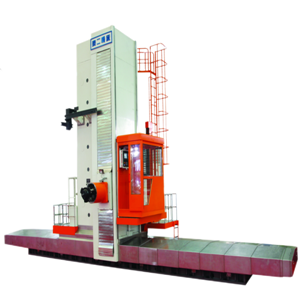
How Can the Machining Efficiency of Large Workpieces Be Improved on Industrial Milling and Boring Machines?
The processing efficiency of large workpieces does not just depend on how much material the machine tool can cut per minute. For boxes, racks, shells and other workpieces with complex structures, workpiece handling, re-clamping, alignment, and equipment conversion between different processes also take up a lot of production time. Through the floor-standing structure and milling and boring compound processing capabilities, the industrial milling and boring machine can improve overall processing efficiency in two directions: reducing auxiliary time and integrating processing processes.
Reduce Repeated Handling and Re-Clamping of Large Workpieces.
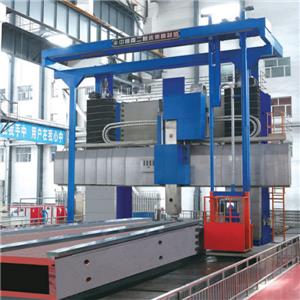
The workpiece has large weight and size, and is frequently transferred between different machine tools, which will increase auxiliary work such as hoisting, positioning and alignment. An important feature of the industrial milling and boring machine is that it can fix large workpieces in the working area and move them to the corresponding position by the machine tool processing system to complete processing. This reduces the need to repeatedly transfer workpieces between different equipment.
If a workpiece has to be machined at several levels of drilling, milling, or connecting the surfaces in different directions, reducing one transfer time will probably shorten one repositioning and auxiliary preparation time.
Try to Complete as Many Processes in One Clamping Session.
If large workpieces require operations such as milling, boring, drilling, reaming and tapping separately, and these processes need to be completed on different equipment, more sequencing time will occur during the production process. Therefore, when selecting equipment, you can pay attention to whether the industrial milling and boring machine has compound processing capabilities such as milling, boring, drilling, reaming, and tapping.
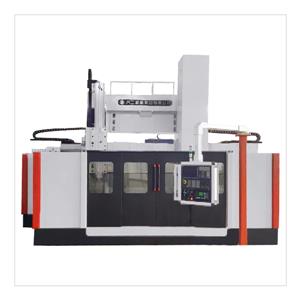
DALIAN WAJI's T69 series industrial milling and boring machine can complete milling, boring, drilling, reaming and tapping operations according to processing requirements. For large workpieces that require multiple processes, this process integration can reduce workpiece turnover between equipment and make the production process more centralized.
A Larger Machining Range Helps Reduce "Segmented Machining".
Insufficient machining range of machine tools is also a problem in processing large workpieces. If the equipment cannot cover the entire processing area on the workpiece, it may be necessary to change the position of the workpiece or even re-clamp it. For large size workpieces, this process not only consumes time, but also increases the complexity of the production organization.
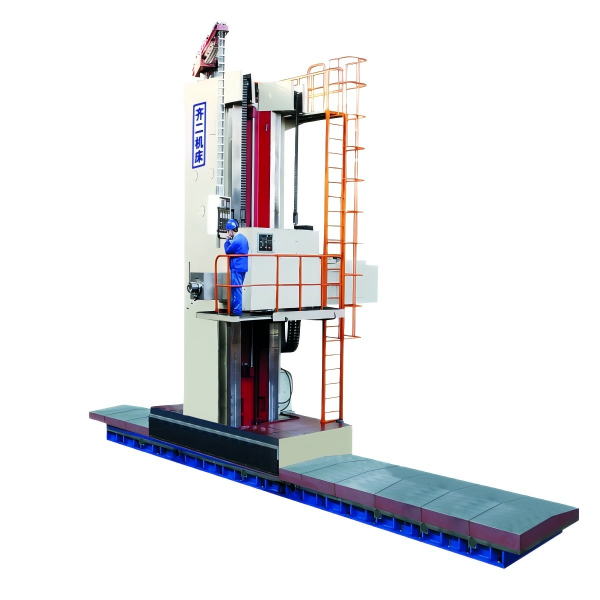
Our industrial milling and boring machine adopts a mobile column structure and a modular design, and different models can correspond to different processing ranges. Some models can have column strokes of 4,000 - 10,000 mm, boring shaft diameters cover 130 - 260 mm, boring shaft strokes cover 800 - 1,500 mm, and headstock strokes cover 2,000 - 5,000 mm.
Therefore, when purchasing, we cannot just look at a certain "maximum stroke", but should judge the overall size of the workpiece, the area to be processed, and the distance between different hole positions together.
Auxiliary Rotary Tables Can Be Considered for Complex or Oversized Workpieces.
For some large disk parts, ring parts or workpieces that require multi-angle machining, relying solely on the movement range of the machine body may not be enough.
Our T69 series can be equipped with an auxiliary rotary table to meet the processing needs of some large workpieces. Through reasonable workpiece positioning and rotation schemes, the processing area that the equipment can cover can be expanded and the adjustment of workpieces to adapt to different processing directions can be reduced.
Modular configuration helps match actual production tasks.
The processing needs of large workpieces vary widely.
· Some mainly carry out deep hole boring
· Some require milling and boring combined processing
· Other workpieces require a greater range of movement.
Therefore, instead of simply selecting the equipment with the largest specification, it is better to determine the configuration based on the actual workpiece. DALIAN WAJI adopts a modular design. Different models have differences in boring shaft diameter, shaft stroke, etc., and can be selected according to the actual processing task. Processing plans such as machine tool configuration, tools and fixtures can also be further discussed based on the workpiece drawings, processing requirements and production conditions provided by customers.
From "Stand-Alone Efficiency" To "Overall Production Efficiency".
What really needs to be calculated to process parts is not simply the cutting time, but:
Total processing cycle = clamping and alignment + process conversion + workpiece transfer + actual processing + auxiliary operation.
The efficiency value that industrial milling and boring machine can bring is mainly reflected in reducing unnecessary clamping, transfer and process conversion. At the same time, through the larger processing range and composite processing capabilities, more processing tasks can be concentrated on one equipment.
When purchasing industrial milling and boring machines, it is recommended to focus on what processes can be completed in one clamping process, what processing areas the equipment can cover, whether an auxiliary rotary workbench is needed, and whether the machine tool configuration matches the existing production process. These factors better reflect the impact of equipment on overall production efficiency than comparing a single machine tool parameter alone.