
Manual Scraping vs. Mechanical Grinding: Why High-End Vertical Lathes Cannot Do Without This Traditional Craft?
In the era of the Industrial Internet—a time defined by the relentless pursuit of production efficiency—DALIAN WAJI CNC MACHINE CO., LTD. continues to preserve a technique that appears primitive yet is, in reality, remarkably precise: manual scraping. This process embodies the enduring legacy of the "craftsman spirit" and serves as the cornerstone for ensuring the long-term precision, vibration resistance, and smooth sliding motion of heavy-duty machine tools.
Going Beyond Mechanical Grinding: Manual Scraping.
While a metal surface finished by mechanical grinding may appear flat to the naked eye, under high-magnification microscopy, its surface texture reveals a pattern of uniform, parallel grooves—a structure that allows lubricating oil to drain away with ease. Consequently, when a vertical turning and milling machining center performs heavy-load operations, localized dry friction can easily develop between the guide rails, leading to the phenomenon known as "crawling" (or the Stick-Slip Effect).
Through the skillful manual manipulation of scraping tools, Dalian Waji’s veteran technicians create a pattern of evenly distributed scraping points—each of optimal depth—across the surface of the guide rails. On a microscopic level, these points form a myriad of tiny "oil reservoirs," capable of generating a durable hydrostatic and hydrodynamic oil film between the moving components. This oil film significantly reduces the coefficient of friction, thereby ensuring that our high-speed CNC vertical lathes maintain exceptional positioning accuracy and repeatability, even during minute-increment feed movements.
Incorporating "Central Convexity":
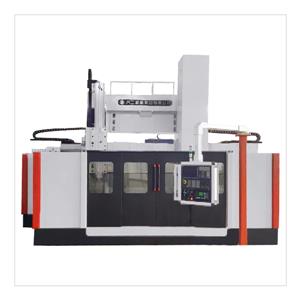
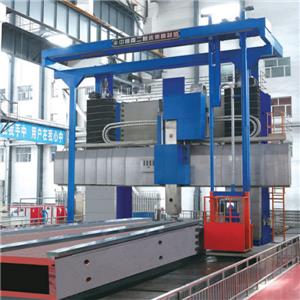
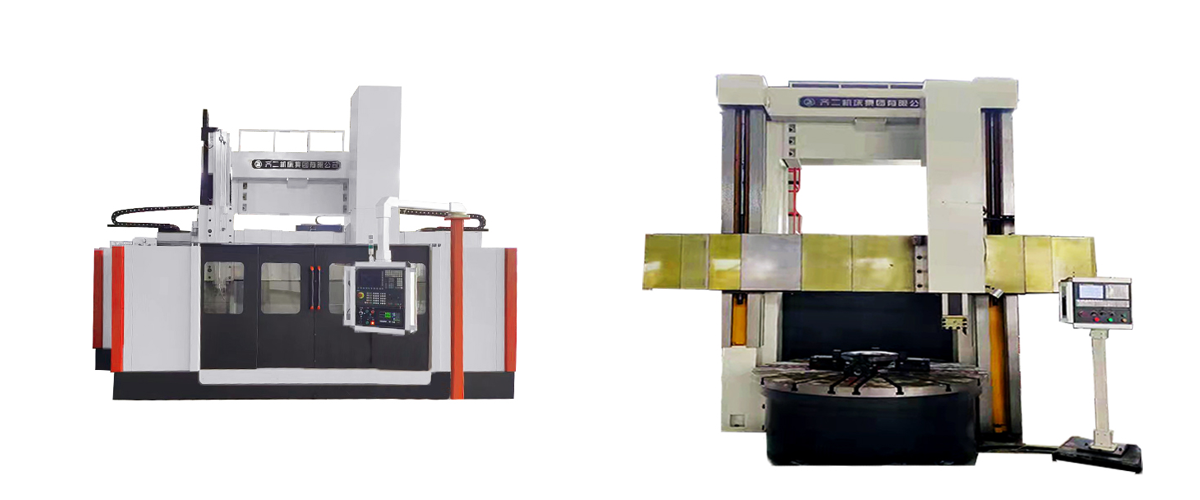
For large-scale, conventional double-column vertical lathes—characterized by their wide crossbeam spans and the heavy tool turrets mounted upon them—gravitational forces inevitably induce a slight downward deflection. During the scraping process, Dalian Waji does not merely aim for surface flatness; drawing upon simulations derived from material mechanics, we meticulously engineer a scientifically calculated degree of "central convexity" into the crossbeam guide rails.
Once the tool turret—weighing several tons—is installed and seated in place, the gravitational load causes the crossbeam to settle into a state of perfect horizontal alignment. This technique of pre-compensation—specifically tailored to the machine's operational load state—is a level of precision that no automated grinding machine can achieve on its own. Through this meticulous geometric refinement, we guarantee consistent machining accuracy across the machine tool's entire operational range.
The Core Combination at Dalian Waji:
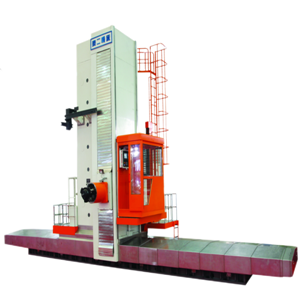
The Perfect Synergy of Manual Scraping and PTFE Soft Strips. To further enhance wear resistance, we have lined the sliding surfaces of the machine tool's tool post and the contact surfaces of its guide rails with Polytetrafluoroethylene (PTFE) soft strips. Through the meticulous hand-scraping performed by our skilled technicians, these PTFE strips form a perfect metal-non-metal friction pair with the cast iron guide rails. This approach has been thoroughly validated on Dalian Waji’s fixed-column CNC milling and boring machines: even under continuous, high-intensity cutting operations spanning 24 hours, the dynamic response remains highly sensitive—a feature that significantly extends the machine tool's "Accuracy Life."
Choosing Dalian Waji means selecting a precision system that stands the test of time. Only by utilizing heavy-duty CNC equipment—crafted with the dedication of expert hand-scraping—can you ensure long-term performance stability and achieve truly exceptional results.