
Precision Lathe Machine for Wind Turbine Components
Wind power parts have the characteristics of large diameter, high weight, and obvious annular or disk structure. Traditional horizontal turning may face higher processing difficulties in terms of clamping, supporting and multiple positioning. For such workpieces, the precision lathe machine can use a large vertical workbench to carry the workpiece and complete key machining such as outer circles, inner holes, and end faces around the same center of rotation.
For wind power parts that require circumferential holes, grooves or secondary milling, if the equipment is equipped with functions such as C-axis and power tools, workpiece transfer and re-clamping can be further reduced.
Why Are Wind Power Parts Suitable for Vertical Turning?
Some key components in wind power equipment, such as large bearing rings, flanges, hub parts, and some shells and connections, will have the characteristics of large diameter, heavy load, and short axial size.
When selecting a vertical turning center, you should not only look at the maximum turning diameter, but also consider:
· Maximum diameter and height of workpiece
· Weight of workpiece
· Worktable diameter and bearing capacity
· Travel and reach range of tool holder/turret
· Cutting force during rough machining
· Whether there is intermittent cutting of the workpiece
· What turning or compound machining needs to be completed in the end
These factors together determine whether the equipment can stably complete actual production tasks.
Why Do We Pay Attention to "One-Time Clamping" In the Processing of Large Wind Power Parts?
Large-scale wind power ring parts and bearing parts are usually processed in large size. Re-hoisting and positioning not only increases the assistance time, but may also increase the risk of error caused by benchmark conversion.
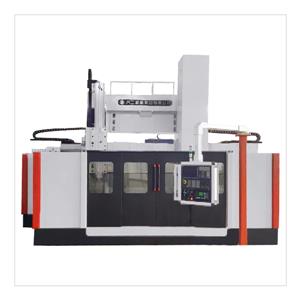
The working method of vertical turning is to mount the workpiece horizontally on a rotating workbench. For large disk and ring workpieces, the weight of the workpiece can be directly carried by the workbench, thus forming a clamping method suitable for processing large parts. Dalian Waji's precision lathe machine adopts a double-column structure, a large vertical workbench and a RAM-type tool holder structure, which is suitable for large rings, bearing parts, wind power parts, etc.
Therefore, in the procurement of wind power parts, priority can be given to judging whether a unified processing benchmark can be established for the main surfaces that need to be processed in one assembly?
If the answer is yes, the vertical machining solution will be more worthy of further evaluation.
When Is the C-Axis Worth Configuring?
Not all wind power components must use C-shafts. If the workpiece mainly performs:
· External turning
· Inner hole boring
· Face turning
· Step processing
· Ring groove processing
· Cone machining
Standard CNC Vertical Turning Configurations Can Meet Major Machining Needs.
However, if the part needs to be positioned in the circumferential direction after turning, such as machining holes, grooves or other features at a specific angle, then the C-axis will be more suitable.
The C-axis allows the workbench to be positioned circumferentially according to a set angle, allowing turning and some subsequent machining to be established on the same clamping benchmark. Dalian Waji's precision lathe machine determines whether an additional C-axis, power tool or measurement function is needed based on the workpiece drawings and machining requirements.
Dalian Waji's Precision Lathe Machine Can Be Used as a Selection Reference.
Our series of equipment adopts a double column structure, a cross beam, a large vertical workbench and a RAM type tool holder. The products are positioned for stable turning of large parts.
It can be implemented in manufacture such as the creation of large rings, gear blanks, bearings, wind power parts, valve pieces, hydraulic generator parts, and pressure vessel heads.
Buyers of the turbines for windmill farms should go one step further and not just make their purchase decision through models, but have the following parameters checked according to the actual workpiece before purchase:
| Selection Criteria | Key confirmation when purchasing wind power parts |
| Maximum Turning Diameter | Whether the blank and finished product size is covered |
| Table Diameter | Whether it is suitable for workpiece clamping and positioning |
| Workpiece Weight | Whether it meets the actual blank weight |
| Workpiece Height | Are the tool and RAM strokes sufficient |
| Cutting Force | Whether the load requirements are met during rough machining |
| Machining Method | Simple turning still requires compound machining |
| C-Axis Requirement | Whether there is circumferential positioning, hole/groove processing, etc. |
| Clamping Method | Whether secondary hoisting and re-alignment can be reduced |
Taking some models of our D series as an example, the maximum turning diameter covers 2500 - 4000 mm, and the maximum workpiece weight reaches 12 - 32 tons depending on the model; the specific model still needs to be confirmed based on the actual workpiece size, weight and processing requirements.
When Purchasing Wind Power Parts Processing Equipment, What Is Recommended First?
As a manufacturer with more than 20 years of experience in machine tool production, we recommend that buyers provide complete workpiece information:
· Maximum/minimum diameter of workpiece
· Height
· Weight
· Materials
· Blank allowance
· Processing drawings
· Annual output
· Accuracy requirements
This information should be taken into consideration by Dalian Waji to decide which workbench, machining range, tool holder travels, if there is a requirement for the supplementary C -axis, power tools or the measuring function.