
CNC Machining Requirements for Wind Power Components
As wind power equipment continues to grow in size, the manufacturing of wind power components is facing increasingly complex machining conditions. Key components such as main bearings, main bearing housings, and generator rotor hubs are not only large and heavy, but some machining areas also require high levels of dimensional accuracy and surface quality.
For manufacturers, the real challenge is not simply that “the workpieces are getting bigger.” Large wind power components often also involve high cutting loads, long machining cycles, and multiple machining operations. Maintaining machining quality while controlling vibration, tool wear, and non-cutting time under these conditions is becoming an important requirement for CNC equipment. Wind power equipment is only one category of large energy equipment — hydropower and other energy equipment components face similar machining challenges (see our article on the main challenges in machining large energy equipment components).
1. The Machining Challenges of Large Wind Power Components Start with the Workpiece Itself
Take wind turbine main bearings as an example. These components require machining of inner and outer raceways, with demanding requirements for dimensional accuracy and surface quality. During intermittent cutting of large forged-steel workpieces, fluctuations in cutting forces can lead to vibration and tool wear. Heat generated during long machining cycles may also affect dimensional stability.
These problems cannot be solved simply by increasing cutting speed.
Consider the case of wind turbine main bearings. These parts necessitate machining of the inner and outer raceways that requires high precision for dimensions and smooth surface quality. In intermittent machining of large forged steel workpieces, variations in cutting forces may result in vibrations and tool wear. Long machining operations generate heat which in turn may affect the dimension stability.
Main bearings are not the only components that require attention. Large rotary components such as main bearing housings and generator rotor hubs also need suitable machining methods based on their structure and machining requirements.
2. Different Components and Machining Routes Create Different Production Problems
Although wind power components are all large equipment components, their machining requirements are not exactly the same.
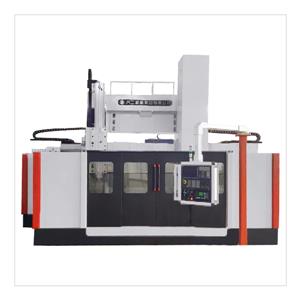
For large rotary components, turning may account for a major part of the machining process. In this case, factors such as workpiece diameter, weight, rotational machining requirements, and the accuracy of critical surfaces can all affect the selection of a Vertical Turning Lathe Machine.
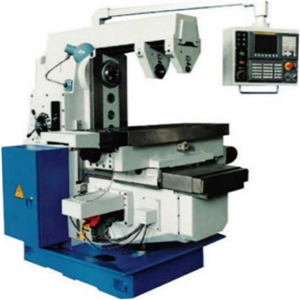
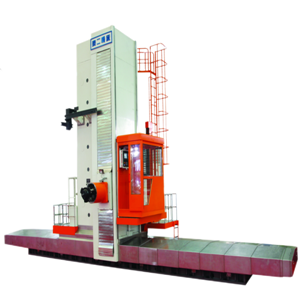
However, when a large component contains multiple machining surfaces and requires milling, boring, drilling, tapping, and other operations, the issue is no longer simply whether the machine can perform the cutting. It is also about how to reduce repeated setups and non-cutting time between different operations.
This is particularly important for large wind power components. Because the workpieces themselves are large, every repositioning may involve additional preparation and machining time. If different operations have to be transferred between different machines, the overall production cycle can become longer.
Therefore, the value of CNC equipment in wind power component machining is not only its cutting capability. Manufacturers also need to consider how many actual machining requirements can be covered by one machine and how different operations can be connected more efficiently.
3. Machine Selection Should Follow the Machining Task
Although wind power components are generally large equipment parts, their actual machining tasks can vary considerably.
For example, main bearing housings and generator rotor hubs may both have large dimensions and high weights, but the machining requirements are not necessarily the same. In addition to the overall size of the workpiece, the machining surfaces, hole systems, and specific operations should all be considered when determining the machining approach.
For components mainly requiring large-scale rotary machining, attention should be given to the rotational machining requirements of the workpiece and the quality of critical machining surfaces when selecting a Vertical Turning Lathe Machine.
For components with multiple machining surfaces that require milling, boring, drilling, and tapping, the equipment needs to cover a broader range of machining tasks while reducing unnecessary repeated setups wherever possible.
This is a practical consideration in wind power component manufacturing. The larger the workpiece, the more significant the time and operating costs associated with repositioning, alignment, and transfer can become.
Therefore, machine selection should not simply start with the question of “which type of machine is suitable for the wind power industry.” It should first identify what the specific component needs to be machined and how the entire machining process should be organized.
4. From Simply “Being Able to Machine” to a More Suitable Machining Solution
For manufacturers, the first step in selecting CNC equipment is to clearly define what needs to be machined on the specific workpiece.
If the main requirement is large-scale rotary machining, manufacturers need to confirm whether a Vertical Turning Lathe Machine can accommodate the workpiece size, weight, and major machining requirements. If the component involves milling, boring, drilling, tapping, and other operations, factors such as machining range, spindle specifications, machining heads, and CNC rotary tables also need to be considered.
More importantly, these parameters need to be evaluated within the actual production process: Which operations can be completed on the same machine? Which operations may create longer non-cutting time? Does the workpiece require frequent repositioning? Do the machine configurations really correspond to the current component structure?
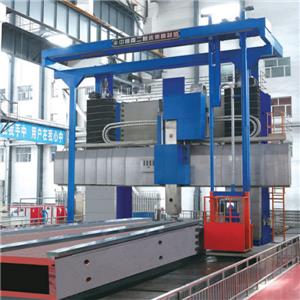
For large complex workpieces, the equipment configuration needs to match the actual machining tasks. Different workpieces may require different spindle specifications, axis travels, machining heads, and table configurations. If the machining range does not match the workpiece structure, even a machine with substantial machining capability may require additional setups, transfers, or auxiliary machining processes.
For example, the TK69 Series can be configured with different spindle diameters, X/Y/Z/W-axis travels, power specifications, and machining heads according to different machining requirements. This type of configuration is suitable for applications where machine capabilities need to be matched to the size and specific machining tasks of large workpieces.
Conclusion
The machining challenges of wind power components are not simply a result of increasing size. Large dimensions, accuracy requirements, multi-operation machining, and long machining cycles can all exist at the same time. For main bearings, manufacturers need to pay attention to accuracy, vibration, thermal changes, and tool wear during raceway machining. Other large components may involve multiple machining surfaces, multiple operations, and repeated setups.
Therefore, CNC equipment selection should start with the specific component and its machining requirements rather than simply choosing a machine type based on the industry it serves. By first identifying the machining problems that need to be addressed and then matching the appropriate machine structure and configuration, manufacturers can make CNC equipment better suited to the actual production requirements of wind power components.
If you are evaluating CNC equipment for wind power component manufacturing, you can provide your workpiece dimensions, machining requirements, and production conditions to discuss a suitable machining approach and machine configuration with Dalian Waji.