
Why Machine Travel Does Not Tell the Whole Story in CNC Machining
Consider the case of wind turbine main bearings. These parts necessitate machining of the inner and outer raceways that requires high precision for dimensions and smooth surface quality. In intermittent machining of large forged steel workpieces, variations in cutting forces may result in vibrations and tool wear. Long machining operations generate heat which in turn may affect the dimension stability.
Consider the case of wind turbine main bearings. These parts necessitate machining of the inner and outer raceways that requires high precision for dimensions and smooth surface quality. In intermittent machining of large forged steel workpieces, variations in cutting forces may result in vibrations and tool wear. Long machining operations generate heat which in turn may affect the dimension stability.
Consider the case of wind turbine main bearings. These parts necessitate machining of the inner and outer raceways that requires high precision for dimensions and smooth surface quality. In intermittent machining of large forged steel workpieces, variations in cutting forces may result in vibrations and tool wear. Long machining operations generate heat which in turn may affect the dimension stability.
1. Machine Travel Describes the Movement Range, Not the Complete Machining Space
The axis travel of a machine tool primarily indicates how far its moving components can cover in a particular direction.
For example, X-axis travel represents the movement distance in one direction, while the Y-axis and Z-axis correspond to movement in other directions. These figures are certainly important to buyers because they establish the basic range of machine movement.
However, actual machining is not simply a matter of moving the machine along one axis until it reaches the other end of a workpiece.
Consider the case of wind turbine main bearings. These parts necessitate machining of the inner and outer raceways that requires high precision for dimensions and smooth surface quality. In intermittent machining of large forged steel workpieces, variations in cutting forces may result in vibrations and tool wear. Long machining operations generate heat which in turn may affect the dimension stability.
Consider the case of wind turbine main bearings. These parts necessitate machining of the inner and outer raceways that requires high precision for dimensions and smooth surface quality. In intermittent machining of large forged steel workpieces, variations in cutting forces may result in vibrations and tool wear. Long machining operations generate heat which in turn may affect the dimension stability.
Therefore, axis travel is more accurately understood as a set of basic parameters describing the machine's movement capability, rather than a complete definition of its actual machining area.
2. Workpiece Position Also Affects the Usable Machining Area
In addition to the dimensions of the workpiece itself, its position on the machine can also affect the actual machining range.
The same workpiece, when positioned differently, will have a different relative relationship with the machine's moving components.
This is particularly important when machining large workpieces.
When the workpiece is large, buyers often first consider whether the machine can accommodate its overall dimensions. But several additional questions need to be considered:
·Which locations on the workpiece need to be machined?
·In what directions are the required machining surfaces located?
·Can the spindle reach the target positions?
·Is there sufficient space for the tool to approach?
·Can movement in different directions cover the actual machining area?
Therefore, a workpiece fitting within the machine's basic travel range does not necessarily mean that all required machining locations can be reached as expected.
The actual machining area is the result of the machine's movement range combined with factors such as workpiece position and machining method.
For large workpieces, the positioning method and the location of the required machining areas can have an even more noticeable effect on the actual machining space.
3. Different Machining Operations Have Different Space Requirements
Even when the workpiece dimensions and position remain unchanged, different machining operations may have different requirements for the machine's working space.
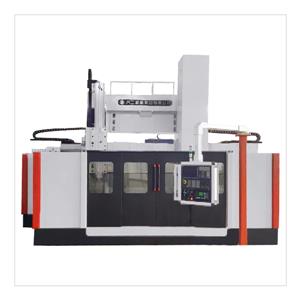
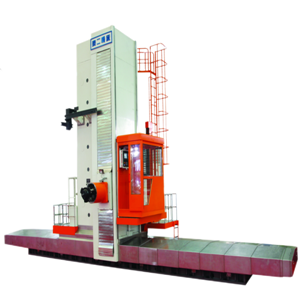
For example, milling, boring, drilling, and tapping are all common machining operations considered when evaluating equipment such as a CNC Boring Mill, but the direction from which the tool enters the workpiece, the machining location, and the required movement are not necessarily the same.
Machining an easily accessible external surface is different from machining an internal hole, a deep hole, or a surface located in another direction. These operations naturally place different requirements on the available space around the workpiece.
This means that when evaluating a machine tool, buyers should not focus only on how far the machine can move. They also need to consider:
Consider the case of wind turbine main bearings. These parts necessitate machining of the inner and outer raceways that requires high precision for dimensions and smooth surface quality. In intermittent machining of large forged steel workpieces, variations in cutting forces may result in vibrations and tool wear. Long machining operations generate heat which in turn may affect the dimension stability.
Therefore, when evaluating a machine tool such as a CNC Boring Mill, buyers should not focus only on how far the machine can move.
4. Multiple Motion Parameters Jointly Determine the Actual Machining Envelope
For CNC machine tools with relatively complex structures, looking only at the X, Y, and Z figures is still not enough.
During actual machining, different moving components work together to complete positioning and feed movements. In addition to basic axis travel, the machine structure needs to be considered to understand how the spindle, tool, and related machining components can approach the workpiece.
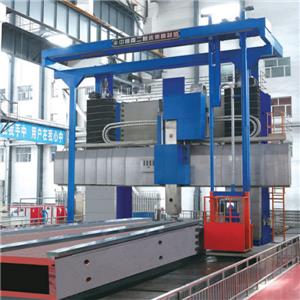
This is especially relevant when machining large workpieces. The workpiece may not simply be positioned at the center of a regular machining space. Different machining surfaces, hole locations, and machining directions can all change the actual machining path.
Therefore, the actual machining space is better understood as a working envelope formed by multiple movement ranges and approach conditions, rather than as a single length represented by one parameter.
From this perspective, the different figures in a machine tool specification sheet are not independent numbers.
What buyers really need to understand is what kind of machining coverage these parameters can provide when considered together for a specific workpiece and machining task, especially when evaluating equipment such as a CNC Boring Mill. The way multiple motion parameters are ultimately combined to achieve a suitable machine tool configuration is also an important consideration when selecting equipment (see How Machine Tool Configuration Affects the Entire Machining Process).
5. How Should Buyers Understand Machine Travel Parameters?
After understanding the difference between machine travel and the actual machining area, buyers can evaluate machine specifications from several perspectives.
First, understand the workpiece itself. In addition to its overall dimensions, it is important to identify its weight and the actual locations that need to be machined.
Second, define the specific machining tasks. Buyers need to determine whether the workpiece requires milling, boring, drilling, tapping, or a combination of multiple operations.
Third, consider whether the target machining locations can actually be reached. Even if the workpiece dimensions fall within the machine's basic travel range, it is still necessary to confirm whether the spindle and tool can effectively reach the required positions.
Finally, consider multiple parameters together. X-axis, Y-axis, and Z-axis travel, along with other parameters related to machine movement and machining, should be evaluated in the context of the specific workpiece and machining tasks.
Compared with simply looking for the largest travel figure, this approach is closer to the requirements of actual machining.
Conclusion
Machine Travel Is Only One Part of Machining Capability
Consider the case of wind turbine main bearings. These parts necessitate machining of the inner and outer raceways that requires high precision for dimensions and smooth surface quality. In intermittent machining of large forged steel workpieces, variations in cutting forces may result in vibrations and tool wear. Long machining operations generate heat which in turn may affect the dimension stability.
Therefore, when comparing CNC machine tools, instead of simply looking for greater X-axis, Y-axis, or Z-axis travel, it is more useful to ask:
Does the machine's actual working space cover my workpiece and the machining tasks that need to be completed?
For large and complex workpieces, this question can be more meaningful than comparing any single machine parameter.
If you have questions about the actual machining range or configuration of a CNC Boring Mill, feel free to contact Dalian Waji to discuss your specific machining requirements.